

Kazuhito Kawai: Precious Time is on view at KOTARO NUKAGA, Tokyo
May 17 – June 28, 2025
KOTARO NUKAGA is pleased to present “Precious Time,” a solo exhibition by Kazuhito Kawai, running from May 17 to June 28, 2025. Born in 1984, Kawai has developed a practice centered on ceramics that gives physical form to interior movements—emotions, memories, and desires. In recent years, he has steadily gained recognition both in Japan and internationally, with notable appearances including GO FOR KOGEI 2023 and the acquisition of his work by the Victoria and Albert Museum in London. In this exhibition, Kawai explores a new direction in his ceramic expression by juxtaposing the “ideal image of the family”—a vision imprinted upon him through late-1990s and early-2000s pop culture—with the reality of his present self.
The exhibition’s key visual features a staged family portrait in which Kawai plays the role of “father” at the dinner table. The scene, reminiscent of a moment from a 1990s television drama, is bathed in stylized lighting that lends the image an uncanny sense of artificiality. Sharing sukiyaki with his family, perhaps casually asking about their day at school—this image evokes the heteronormative nuclear family Kawai longed for as a child, a fantasy shaped by media and deeply internalized over time. The photograph was staged specifically for this exhibition, embodying the dissonance between that ideal and the reality of his life.
This gap between fantasy and reality was also central to Kawai’s 2024 solo exhibition ‘Today’s Close-Up Ceramics – Even If I Become an “Ojisan”’ curated by Yuji Akimoto. At its core lies a deeply personal yet widely relatable theme: the slow realization that the future we once envisioned seldom arrives as expected. Crucially, Kawai is not simply highlighting the tension between dream and reality. Rather, he focuses on the persistence of certain ideals—romanticized visions of life and value systems absorbed in youth—that remain lodged within his identity, even when they no longer align with the life he has lived.
Cultural theorist Lauren Berlant described this dynamic as “cruel optimism”—a structure in which people continue to attach themselves to desires or ideals that no longer serve them, or perhaps never did. In her seminal 2011 book, Cruel Optimism, Berlant suggests that clinging to unachievable ideals—such as upward mobility or a stable family life—can paradoxically become the very conditions that make life possible. These attachments, she argues, are not merely longings for an object, but are bound up in the desire to sustain one’s own continuity—an ongoing narrative of endurance.
For Kawai, the ideal of family becomes a cruel attachment: a vision once embraced in innocence and still impossible to relinquish. The optimism conveyed through late-90s and early-2000s television dramas and advertisements—crafted during Japan’s tentative recovery from the burst of the bubble economy and its cautious hope for a near-future utopia—has transformed into a kind of collective nostalgia. These images, no longer attainable yet impossible to forget, remain embedded as a deeply personal narrative. Suspended between individual memory and cultural construction, they become ambiguous, ambivalent—neither entirely optimistic nor wholly tragic.
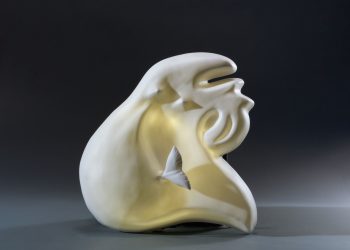
This fragile, internalized longing finds powerful expression in Kawai’s ceramics. The titles of his works(such as Love Phantom), the use of decorative elements like uchiwa fans bearing late-90’s pop-star Ayumi Hamasaki’s symbol, and color palettes that evoke particular cultural moments from the era all serve as visual indexes of memory. His works frequently employ pastel hues and forms reminiscent of toys and stuffed animals, gestures often described as “cute” or humorous. Yet, as theorist Sianne Ngai has argued in Our Aesthetic Categories(2012), cuteness is not merely an aesthetic but a relational form—one that conveys vulnerability, asymmetry, and dependency. In Kawai’s forms, these images of things “to be protected” are often excessively adorned, while beneath their glossy surfaces lie signs of bruising and imminent collapse. Cuteness here becomes not just a visual pleasure, but a performance masking instability—an imperfect disguise that inevitably gives itself away.
This introspective use of ceramics departs significantly from the traditions of the medium that emphasize harmony between material and spirit. Clay, with its pliable, mutable, and ultimately fragile nature—its susceptibility to drying, cracking, and chemical transformation in the kiln—becomes an ideal conduit for articulating the inner tension between reality and aspiration. Built upward from the base, Kawai’s ceramic forms appear as if on the verge of melting, standing in a state of near-collapse. The effects of gravity and the accidents of chemistry are not technical flaws but poetic parallels to the nostalgic and delicate desires of his youth. His choice of clay is not incidental but essential.
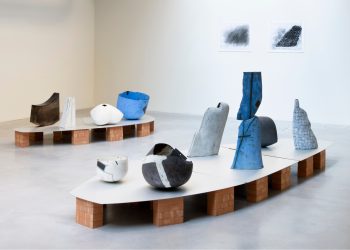
In this exhibition, Kawai presents these ceramic works alongside found images from the internet—fragments of the media landscape that shaped his ideals. The juxtaposition of staged “ideal” imagery and materially decaying clay forms establishes a dialogue between performance and failure. If the photograph of Kawai enacting the role of father is an attempt to conform to a socially prescribed narrative, then the ceramic works are the sediment of failed performances—the architectural ruins of roles that could not be fulfilled. Long used as vessels, ceramics in Kawai’s practice form hollow structures, containers of nothing, filled instead with the residue of longing and memory.
The exhibition title, Precious Time, borrows from a 1998 Japanese TV drama of the same name. But here, the phrase is not a nostalgic return to an unreachable ideal—it is a desperate plea from a body trapped in performance, asking for just a little more time. Neither able to exit the stage nor fully inhabit the role, the body lingers somewhere in between. The father figure Kawai performs in this exhibition is not a conclusion but a symbol of unfinished acting. In the staged family portrait, he continues “trying to become” the image that has defined him. He resists the interruption of that act, yet perhaps, somewhere within, he is waiting for it to end.
This is not a lament over failed roles. It is a testament to a body that still longs to establish a tangible relationship with frameworks it can never fully inhabit. The deformation of clay, the dripping glaze, the unsealed surfaces—these are not signs of failure but structural expressions of performance itself: uncompleted, ever-crumbling, and persistent. The exhibition’s central photograph and its ceramic works together present two modes: one of living a role never granted, and the other of tracing the fragile imprints left by a body that has overflowed its mold. The photograph re-enacts the ideal through composition and pose, while the ceramic forms preserve their deformations—the run of glaze, the rough interior of the hollow—as the material embodiment of a personal narrative. That tactile rawness becomes not only a shard of the artist’s imperfect life, but also a surface upon which the viewer may project their own.
Contact
info@kotaronukaga.com
KOTARO NUKAGA (Tennoz)
TERRADA Art Complex II 1F
1-32-8 Higashi-Shinagawa
Shinagawa-ku, Tokyo
140-0002 Japan
Photos courtesy of the gallery